Eight of Swords Tarot Card Meaning
Messages:
Feeling Trapped
Limiting Beliefs
Self-Imposed Restrictions
Mental Prison
Fear
Self-Doubt
Overthinking
Confusion
Helplessness
Victim Mindset
Anxiety
Emotional Paralysis
Negative Thinking
Lack of Freedom
Uncertainty
Blind Spots
Inner Conflict
Mental Block
Perceived Limitations
Seeking Clarity
Awakening
Self-Reflection
Breaking Illusions
Inner Strength
Path to Liberation
Count the Gaps
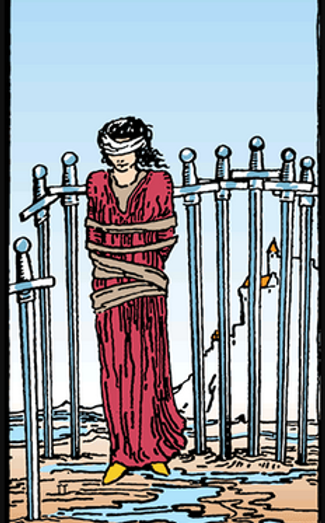
The Eight of Swords looks like a trap until you look at it properly. A woman stands alone with her arms bound to her sides by loose cloth and a blindfold over her eyes. Eight swords are driven into the ground around her, arranged in an arc rather than a circle. Look at the spacing and you will see wide gaps between them, especially in front of her. Her feet are free, the ground is muddy but walkable, and nothing is holding her from below. Behind her on a rocky hill stands a castle, distant and unreachable. The bindings around her arms are loose enough that they are already slipping. She could walk out of this in the direction she is facing, and she does not know that.
Bindings That Are Already Loosening
Every element in the Eight of Swords is designed to look worse than it is. Those swords stand behind and beside her rather than in front, so the way ahead is genuinely open. Eight of them is a lot and the arrangement leaves obvious spaces, which is what makes this a mental prison rather than a physical one. The cloth around her arms is fabric rather than rope and it is not tied tightly to anything. Her blindfold is the actual restraint, since being unable to see the gaps is what keeps her still. Wet ground under her feet means walking would be unpleasant rather than impossible. And the castle on the hill represents an authority or situation that feels like it controls you and is a great deal further away than it appears. Distance in here is always exaggerated.
You Are More Trapped in Your Head
When the Eight of Swords appears, you feel stuck and the constraints are less absolute than they seem. That is not the same as saying your problem is imaginary, because the swords are real and the mud is real. It means the situation has fewer walls than you have been assuming. Notice how you describe it, since people in the picture use words like impossible, never and no choice with unusual frequency. Write the situation down and mark which parts are facts and which are predictions. Almost always the facts are fewer and less final than the sentence you have been repeating. That gap is where your options are hiding. Look for the sentence you keep repeating and test it.

Test One Assumption
There is one thing to do here and it is small. Take the belief that feels most solid, the one you have never checked, and go and test it this week. You assume they would say no, that it is too late, that you are not qualified, that leaving would ruin everything. You have almost certainly never asked. Choose one and get an actual answer rather than a predicted one, because a real no is more useful than an imagined one. People are often astonished by how quickly one enquiry dissolves months of stuckness. The blindfold does not come off all at once. It comes off one verified fact at a time.
Notice Who Tied the Cloth
This card asks an uncomfortable question about how you got here. Some of your restrictions were imposed by other people and some you accepted along the way without noticing. Obligations you never agreed to, standards nobody actually holds you to, rules from a job or a family that stopped applying years ago. Ask which of your current limits would still exist if you simply stopped observing them. Some would, and those are worth respecting. Others would evaporate immediately and have been costing you a great deal for nothing. Separating those two lists is most of the work of the Eight of Swords. Do it on paper this week rather than in your head.
Stop Waiting to Be Released
Nobody is coming to untie her, and there is nobody else in the picture at all. That is the hardest part of the Eight of Swords and also the most freeing. You may be waiting for permission, for somebody to notice how difficult things are, for circumstances to change on their own. That wait can last years and it hands the timing of your life to people who are not thinking about it. The way out here is self initiated and it starts smaller than you think. One phone call, one honest sentence, one enquiry. Waiting is comfortable precisely because it feels like nothing is your fault. Nobody is going to arrive and give you permission.
 |  |  |
|---|---|---|
 |  |  |
 |
Small Moves Beat Big Plans
Because everything feels blocked here, people tend to plan enormous escapes and then execute none of them. The mud in this picture is the reason, since dramatic movement is exactly what these conditions do not support. So make the smallest move available rather than the most impressive one. Send the message, book the appointment, tell one person the truth about how you are doing. Each small action shifts your sense of what is possible, and that shift is what actually breaks here. Momentum here is psychological before it is practical. You are not trying to solve it today, you are trying to prove to yourself that movement exists. One small action will change your reading of the whole situation.
What This Card Becomes If You Stay
It is worth knowing what waits further along this suit. The Nine of Swords follows this one, and it shows somebody awake at three in the morning with their head in their hands. That is what happens when a stuck situation is left long enough, because the mind keeps working on a problem you refuse to act on. Reading it that way makes the Eight urgent rather than merely uncomfortable. You do not have to fix everything to avoid that, you only have to start moving. Any direction counts more than the right direction at this stage. The swords never actually closed the circle, and you have been the one keeping the blindfold on. Take it off and walk out through the gap in front of you.