Seven of Pentacles Tarot Card Meaning
Messages:
Generosity
Charity
Giving
Receiving
Balance
Gratitude
Abundance
Prosperity
Reciprocity
Compassion
Kindness
Fairness
Mutual Support
Sharing Resources
Financial Blessings
Philanthropy
Community
Equality
Harmony
Divine Provision
Acts of Service
Good Karma
Helping Others
Material and Spiritual Wealth
Balanced Exchange
He Is Not Working Right Now
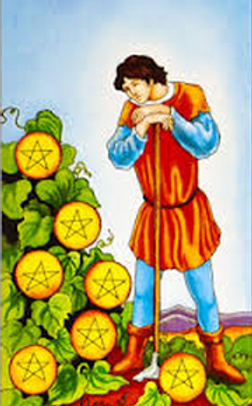
The Seven of Pentacles is the only card in this suit where somebody has stopped. A man stands in a field leaning on the handle of a hoe with both hands, taking his weight off his feet. In front of him grows a tall green bush heavy with leaves, and seven golden pentacles hang from it like fruit. His head is turned down toward the plant and his expression is thoughtful rather than pleased. The ground around him has clearly been worked and the growth is substantial. Nothing is being harvested and nothing is being planted. He is looking at what he has grown and deciding what he thinks about it, and that pause is the entire card. Nothing here is finished and nothing has failed.
Fruit That Is Not Ready Yet
Everything here is about a stage rather than a result. Seven pentacles hanging on the bush means the yield is real and it is still attached, so nothing has been collected. The leaves are green and abundant, showing healthy growth rather than a failed crop. His hoe is a working tool and he is leaning on it rather than using it, which marks a deliberate pause in the middle of the labour. The worked soil beneath tells you months of effort have already gone in. Seven is the number of assessment throughout the deck, so this is the point where you look at what your work has produced. His posture is honest rather than triumphant. This is the moment of asking whether it was worth it.
Take Stock Before You Continue
When the Seven of Pentacles appears, you are being asked to stop and evaluate rather than to push on. That is unusual advice in a suit built on steady effort, and it is exactly why the Seven of Pentacles exists. Look at what your work has actually returned over the last year, in numbers rather than impressions. Ask which parts produced most of the result and which parts produced almost nothing. Most people are surprised to find that a small portion of their effort generated the majority of their outcome. That information is only available if you stop long enough to look. Book the hour and do it properly this week. You cannot see the pattern while you are still inside the work.

Growth Takes Longer Than You Planned
There is a particular frustration in here that comes from timing. Nothing here has failed, and nothing has finished either, which is the least satisfying position to be in. You are probably somewhere in month eight of something you expected to take three. That gap between your estimate and reality is normal and it is not evidence that you chose wrongly. Check whether your impatience is a response to actual poor results or simply to slowness, since those need opposite responses. Slow and working is a completely different situation from fast and failing. In this suit, most things take about twice as long as anybody expects. Adjust your timeline rather than your commitment.
Decide Whether to Keep Watering It
The picture contains a genuine decision rather than only a pause. Some things need more time and some things need abandoning, and telling them apart is the skill here. Ask whether the trend is improving, flat or declining across a long enough period to be meaningful. Ask what evidence would convince you to stop, and notice whether you have quietly made that unfalsifiable. Sunk effort is the most common reason people continue with something dead, since walking away feels like wasting everything spent so far. That money and time are gone either way. The only real question is what the next year of effort would produce. Answer that honestly and the decision usually makes itself.
Do Not Harvest Too Early
There is an opposite mistake worth naming. Impatience in this suit destroys more value than laziness does, because pulling something up to check on it stops the growth. If you are tempted to change strategy, restructure the business, redesign the website or start again from scratch, ask whether you are responding to data or to discomfort. Give a well founded plan a full season before you judge it. Constant adjustment feels productive and it resets your progress each time. The bush in this picture got there by being left alone for long stretches. Give your plan a full season before you rebuild it. Constant adjustment resets the clock every time.
 |  |  |
|---|---|---|
 |  |  |
 |
Rest Is Part of the Work
Notice that he is genuinely leaning rather than posing, and this card gives you permission for that. Long projects require pacing, and the people who finish them are the ones who rest before they collapse rather than after. Look at whether you have taken any actual break in the last six months. Exhaustion also distorts your assessment, which makes this the worst possible state for the evaluation the Seven of Pentacles is asking for. Rest first, then assess, then decide. The order matters more than people think. A tired person almost always concludes that everything is failing. Rest first, then look at the numbers.
What Patience Is Actually For
It is worth understanding where the Seven of Pentacles sits in the sequence. Behind it are the beginning, the juggling, the craft, the holding on, the hardship and the sharing, and ahead of it are dedicated work and eventual security. This is the hinge between effort and reward, and it is where most people give up. Patience here is not passive waiting, it is continuing to tend something while the returns are still invisible. That is the least dramatic quality in the entire deck and it is the one that determines outcomes in this suit. Whatever you are growing is probably closer than it feels. Look at the bush rather than the calendar. What you have grown is closer to ready than it feels.