Ten of Wands Tarot Card Meaning
Messages:
Burden
Responsibility
Hard Work
Perseverance
Dedication
Commitment
Achievement
Endurance
Determination
Duty
Overcoming Challenges
Persistence
Responsibility Overload
Ambition
Final Stretch
Carrying the Weight
Personal Growth
Resilience
Self-Discipline
Strength
Accomplishment
Sacrifice
Completion
Inner Fortitude
Success Through Effort
Bent Double Under the Load
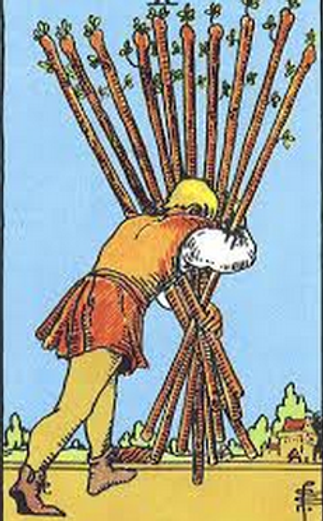
The first thing you notice in the Ten of Wands is a posture rather than a person. A man is bent almost horizontally, both arms wrapped around a bundle of ten heavy wands pressed against his chest. The wands are stacked so high in front of his face that he cannot possibly see where he is walking. His head is down, his back is curved, and every part of the pose says the load is right at the limit of what he can manage. He is not standing still, he is walking, so this is not a moment of collapse. Ahead of him you can see a small town with buildings and a green field, close enough to reach. Nobody else appears anywhere in the picture, and no one is walking beside him. The wands themselves are still leafy and alive, which tells you this weight is not junk, it is everything he chose. That combination, valuable cargo and no visibility, is exactly what the Ten of Wands is describing.
All Ten, Carried in One Armful
Look at what he is actually carrying, because none of it is worthless. Every one of those wands began as a spark like the Ace, a project, an interest, a promise, a responsibility you genuinely wanted. They are still sprouting leaves, so nothing here is dead weight, which is precisely what makes it so hard to put any of it down. Ten is the number that completes a suit, so this is the fire cycle at its absolute limit rather than at its beginning. Notice they are gathered in one bundle instead of being carried in trips, showing you a habit of taking everything at once. His arms are wrapped around them rather than sharing them out, since nobody in this picture has been asked for help. The town ahead means the destination is real and close, so the finish is not imaginary. And the fact that the wands block his view is the sharpest detail, because a load this size stops you seeing the very thing you are carrying it toward.
You Have Taken On Too Much
When the Ten of Wands appears, you are carrying more than your share and you probably know it. This rarely happens through one bad decision, it happens through a long series of reasonable ones. Someone needed help and you were capable, a project needed rescuing and you were available, a role opened up and you were the obvious choice. Each yes made sense on its own, and the total has quietly become unmanageable. Notice that here shows no crisis, since nothing has gone wrong yet, and that is why you keep going. The cost shows up in smaller ways first: you stop sleeping properly, you get short with people, everything takes longer than it used to. Write down every commitment you currently hold, including the informal ones nobody counts. Most people are genuinely shocked by the length of that list, and seeing it is the first honest step.

Put Something Down
The obvious solution in the picture is also the one people resist hardest. You do not need to carry all ten, and at least two of them could be set down today with almost no consequence. Go through your list and mark which items are genuinely yours, which belong to somebody else, and which you kept purely out of habit. There is nearly always something you took on two years ago that nobody would even notice if it stopped. Letting go of it does not make you unreliable, since a person carrying everything badly serves no one well. If putting something down feels impossible, that is worth examining, because it usually means your identity is tied to being the one who copes. Start with the smallest item rather than the biggest, and notice that the sky does not fall. Then do it again next week.
Ask, Because Nobody Will Offer
There is nobody else in the picture, and that absence is the real problem rather than the load. People around you are not refusing to help, they simply cannot see the size of what you are holding. You have probably been very good at making it look manageable, which means the request has to come from you. Be specific when you ask, because vague appeals get vague responses and clear ones get action. Name the task, the deadline and exactly what you want the other person to do. Notice too that delegating properly costs you time upfront and saves you far more later, which is why exhausted people skip it and stay exhausted. If you are in a position of responsibility, this is not weakness, it is the actual job. One conversation this week could take two wands off the pile.
Check What You Are Carrying It For
His view is blocked, and that is the most useful warning in the card. When you are this loaded, you lose sight of why you took any of it on. The work continues on momentum alone, and the original reason quietly disappears behind the bundle. So stop for an hour and ask what this is all in service of, and be honest if the answer is no longer clear. Some of what you carry is serving a version of your life that ended a while ago. Other parts are serving somebody else's expectations rather than your own plans. That hour will not reduce the weight and it will tell you which parts deserve to be carried at all. Purpose is what turns effort into work rather than into grinding.
 |  |  |
|---|---|---|
 |  |  |
 |
The Way You Carry Things Is a Habit
Look at how the bundle is held, because it is inefficient and it is also familiar. Most people who reach this card have been doing it for years, and the load is not the exception, it is the pattern. You take on more than you should, you handle it alone, you say yes before you have checked your capacity. Simply finishing this particular pile will not change anything, since another ten wands will appear within months. If you want a different result, the fix is at the point of intake rather than the point of exhaustion. Practise saying that you will check and come back, instead of answering immediately. Build a rule for yourself, such as nothing new until something is finished. The pile in front of you is the symptom, and your yes is the cause.
You Are Nearly There
There is genuine encouragement in this one and it is easy to miss under all that weight. The town is close, the ground is flat, and he is still walking, which means this stretch has an end. Ten completes the suit, so whatever cycle you are in is finishing rather than beginning. That matters practically, because the fastest way through is usually to deliver what is nearly done rather than to reorganise everything. Finish two things this week and the psychological load drops far more than the actual weight does. Then, before you pick anything else up, take the pause you have been postponing. What you do in the gap after this pile determines whether the next one looks the same. Arrive first, and then decide what you agree to carry next time.