The Hanged Man Tarot Card Meaning
Messages:
Surrender
Letting Go
New Perspective
Spiritual Awakening
Enlightenment
Acceptance
Patience
Inner Wisdom
Divine Timing
Sacrifice
Suspension
Higher Consciousness
Inner Peace
Soul Growth
Reflection
Trust the Process
Spiritual Insight
Transformation
Release
Non-Attachment
Mindfulness
Seeing Differently
Divine Perspective
Self-Discovery
Inner Stillness
The Card You Want to Turn Around
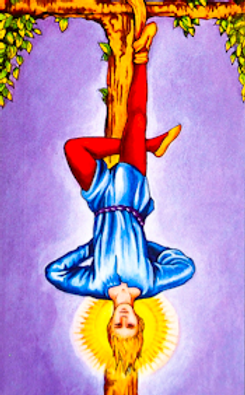
Almost everybody who meets The Hanged Man wants to pick the card up and turn it the right way round, and that reflex is the reading. A man hangs upside down by his right ankle from a wooden beam resting on two living, green trees. His left leg is bent behind the right one, forming the shape of a four, which is the number of stability and structure. His hands are tucked behind his back and his elbows point outward, making a triangle. He wears red trousers, a blue top and yellow shoes, and his clothes are neat rather than torn. Around his head glows a bright halo, and the light clearly comes from inside him rather than from anywhere in the sky. Only one rope holds him, and his hands are free enough that you find yourself wondering why he does not simply untie himself. His face shows no panic at all, just an oddly awake calm, and that question of why he stays is where the card begins for you.
Read It Twice, Once Each Way
The Hanged Man asks you to look at everything in the picture from two directions. Seen normally, a man is hanging helplessly from a tree. Turn the image over and you see somebody standing upright, one leg lifted, almost dancing. The rope looks like a restraint until you notice it only holds his ankle, while his arms and head stay completely free, which makes this a position rather than a prison. The four made by his legs symbolises order and stability, appearing here in a moment when everything else is upside down. The triangle of his arms points downward, showing you that the insight here comes from below rather than above. The beam rests on green, living wood, so this pause is growing rather than dead. And the halo around his head is the whole point, because it tells you something has actually happened in all this stillness.
When the Pause Was Not Your Idea
Most people meet The Hanged Man in a situation they did not choose. A decision sits with someone else. A process drags on. An illness puts you flat. A project stalls even though you did everything right. What makes this so uncomfortable is that your usual remedy for anxiety is blocked, because you cannot fix it by doing more. Your first instinct will be to drown the standstill in activity, and that usually makes it last longer. The Hanged Man suggests something different: stop fighting the situation and admit what it is. That is not the same as giving up, because giving up means you stop caring while accepting means you stop pushing against something immovable. Very often the tension drops the moment you stop treating the wait as a personal failure, and only then does the time become usable.

Look at It From Another Angle
The change of perspective here is meant literally, and you can apply it today. When a problem has not moved for weeks, that is rarely about effort, it is usually about the question you are asking. While you ask how to convince someone, you keep hunting for better arguments. Ask instead why they are hesitating, and the whole task changes shape in front of you. Try some deliberate reversals: what if the opposite were true, what would an outsider see who does not know the history, what if the delay is information rather than an obstacle? These take a few minutes and need no special mood, only your willingness to put your own version down for a moment. If you have been staring at something from one side for a long time, you will often find more in five minutes of this than in five weeks of pushing. The Hanged Man is not up there to suffer, he is up there because he can see something you cannot see standing up.
Give Something Up on Purpose
The Hanged Man is traditionally a card of willing sacrifice, and that part gets skipped far too often. Some things simply cannot be had at the same time, so progress will cost you something. Start training and you give up income and free evenings. Have a child and you give up mobility. Get honest with someone and you give up a comfortable story about yourself. What matters is that you pay that price knowingly, because an unconscious sacrifice turns into resentment aimed at whoever is nearby. Notice that his rope is neatly tied and he could get out, which means he chose this. When you know exactly what you are giving up and what for, you can carry far more than you think. It is also worth checking whether an old sacrifice still serves any purpose or whether it has simply become a habit.
Some of This Is Not in Your Hands
A lot of the discomfort here comes from finding that your usual tools do not work. Your effort, your intelligence and your persistence have carried you this far, and in this situation they barely move the needle, because the decision sits elsewhere. That hits hardest if you are used to producing results through sheer input, since you probably measure your worth by it. The Hanged Man removes that lever, and at first it feels like losing your significance. He is only pointing out something that was always true, because timing, other people's choices and plain circumstance have always shaped your life alongside your work. If you can sit with that without feeling small, you gain a steadiness that will serve you long after this phase ends. In the meantime, pick tasks whose outcome genuinely is yours, even if that is only tidying, exercise or preparation. The Hanged Man is not asking you to stop working, only to stop pushing at the part that will not move.
 |  |  |
|---|---|---|
 |  |  |
 |
The Halo Comes From the Stillness
That light around his head is not decoration, it is the result. Insight rarely arrives under pressure, because a busy mind mostly repeats what it already thinks. Only when your usual reactions are unavailable does something else get a chance to speak up. That is why your most useful thoughts turn up during illness, on long journeys, or in stretches when nothing is moving anyway. You cannot force it, though you can make room for it by not filling every gap with distraction. Keep a notebook during a phase like this and you will usually notice the same two or three themes returning. Those are your real questions, the ones that normally disappear behind your schedule. The Hanged Man does not promise a dramatic revelation, he promises a quiet clearing that you will probably only notice afterwards.
How This Time Will Look Later
Step back and this phase almost always changes character. While you are in it, it feels like wasted time, a gap between two chapters that you would happily skip. Talk to people years after their own version and they often describe it as the point where their direction changed. That happens because decisions get prepared here that you could not even have put into words at the time. If you are in the middle of it, that comfort is hard to accept, and there is no need to pretend otherwise. So do something small and practical instead: write down what you notice, week by week. Those notes look completely ordinary now and turn into the most valuable thing you take out of the period. The Hanged Man never claims that every delay has a hidden purpose, because some hold ups are simply annoying. He only promises that this time can be used, once you stop merely enduring it.